The Snickersnee Press
Devoted to Rediscovering Ben Hecht Biography & Works
431 Fifth Street NE
Washington, DC 20002
fax: 202 547 0132
snickers
Home
December 2020.
Happy, Happy/Merry Merry!
With the winter holidays well underway we bring you Ben Hecht's Christmas story Holiday Thoughts, The master journalist writes about the need to "observe" Christmas, which he sets forth into the city to do with the faithful eye of a reporter.
* * * * * *
Ben Hecht's 1001 Afternoons in Chicago, the literary journalism that coined the term Hechtean, will attain its 100th anniversary next spring.
How best to celebrate? I already catalogued and at least once read each of the 425 (depending how you count) stores. Is it time for us to publish another anthology?
What subjects would most interest the Hecht fans and general readers?
We can probably fill a book with any of numerous genres or subjects. Doctors? Mystery or Weird? Science? Music? Madness? Immigrants? Theater? Amour or such?
Or perhaps something multi-media or seven arts in collaboration with, music, architecture, art, photogrraphy --- and a dose of technology. And why wait until 2021 if we can do something sooner. We will keep you posted. Potential collaborators welcome.
Flori Whyte Kovan, Ben Hecht Biographer
* * * *
From the Archives
Spring in the air with three new publications to buoy Ben Hecht fans! Two biographies just published and a new Hecht primary source: An audiotape of a 1960s speech found and transcribed.
Julien Gorbach in his meticulously researched book, the aptly titled The Notorious Ben Hecht: Iconoclastic Writer and Militant Zionist, sustains the scholarly care he gave to his impressive 600-page PhD dissertation, Crying in the Wilderness, Poet and Outlaw in Ben Hecht's Militant Zionism. More than any other biographer, Gorbach has considered the influence of gangster Mickey Cohen on Hecht's iconoclasm. Of Hecht Gorbach clarified in email today, "My goal is more about what his life meant, and why he is relevant today. . ." Hear and see his interview with Jay Fidell of Communty Matters in Hawaii.
Adina Hoffman's elegantly written Ben Hecht: Fighting Words, Moving Pictures, while sometimes critical, accepts the plausibility of Hecht's storytelling in his memoir A Child of the Century, beginning with his formative years in Racine, Wisconsin. In this setting he cast his visiting aunts and uncles as the storytellers who inspired him as a budding storyteller as they spun their yarns in Yiddish on the porch of the Racine Hotel overlooking Lake Michigan.
After a long dry spell in Hecht biography, both Gorbach and Hoffman consider influences in Hecht's life as he emerged as the humanitarian writer of We Will Never Die, the ill-fated touring pageant documenting the atrocities of the Holocaust in 1943, and, subsequently, became a militant Zionist fighting for an independent state of Israel.
Now the audio of Hecht addressing fellow writers in New York, circa 1960. The tape is in the provenance of Claude Smith, who annotated it with the help of staff at The Newberry Library. The subject of Hecht's talk is memories of his youth as a reporter in 1910s Chicago. Check back for details of the publication of the transcript.
Florice Whyte Kovan
March 20, 2019. Thanks to the kind soul who alerted me that this column had gone cyber-rougue. Time to update! Last month the Chicago Literary Hall of Fame honored Kenneth Sawyer Goodman as a playwright and a collaborator, including with Ben Hecht, in their quest toward modernism in 1910s Chicago. I had the honor of speaking at this occasion to a capacity crowd at the Newberry Library where Goodman's gritty and prescient play about vulnerable Chicago youth, Back of the Yards was presented. My piece on Goodman on the 100th anniversary of his death starts here. Florice Whyte Kovan
Alert: For readers looking for my Hecht book of Chicago Daily News stories Art & Architecture on 1001 Afternoons, we had a rush on the book in the past few weeks, apparently owing to my Szukalski material. Only 200 copies were published and have only three left now, not counting the ones I'm saving for my as yet unborn great-grandchildren. Try Etsy or eBay for a copy.
Florice Whyte Kovan
November 29, 2018
This week marks the 100th anniversary of the death of Chicago's pioneering modernist playwright, Kenneth Sawyer Goodman 1882-1918. Bearing the name more associated with Chicago theater than any other, Goodman now must come into his own in recognition for the dozens of plays he wrote in Chicago Little Theater's pathfinding movement of the 1910s. A good half dozen of these were drafted by Ben Hecht and (more)
November 24, 2018.
Shopping, shopping! Ben Hecht "observed" the Christmas season, its shopping frenzy and the expectation of gifts in his trip to the toy department in this moving piece about childhood memories. Here he identifies the greatest gift of the season: the gift of memory. Read Holiday Thoughts, one of the hundreds of 1001 Afternoons in Chicago stories I found not compiled in the 1922 Covici imprint.
Florice Whyte Kovan
Photograph Above, Library of Congress General Collections
World War I in Hecht's Chicago
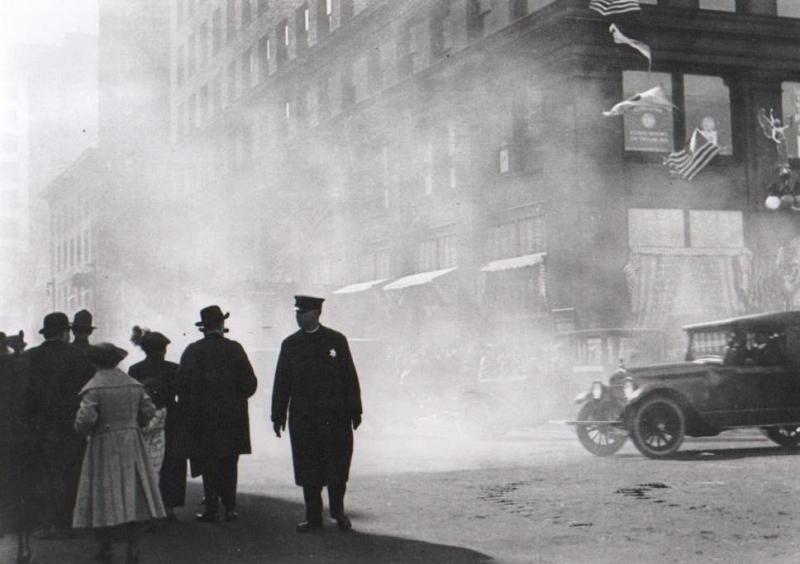
Photograph, Hazy street scene in Chicago, on First Victory Loan Day, Courtesy Library of Congress Prints and Photographs Division .. LC-USZ62-111129.
Hello Readers,
This month we observe the 100th Anniversary of the end of World War I, The Great War, the "war to end all wars" as it was called before the sons of veterans and war dead were called to fight in the next war, World War II, a short generation later.
Ben Hecht, an army reservist subject to the lottery, observed World War I safely, writing plays to support the war effort and covering the aftermath of the war in Germany. Here in his short story Vox Populi, written as one of his 1001 Afternoons in Chicago columns, he sees an all-too-familiar sight: a shell-shocked war veteran selling trinkets at the Illinois Central commuter train station. I found this storyin my Library of Congress research in the old Chicago Daily News, one of hundreds never reprinted or compiled. Read it here as Hecht speaks in the voice running through the minds of some passersby, "Take this man away. He annoys me. I have worked hard all day. I have . . .
Florice Whyte Kovan
Read Hecht's Holiday Thoughts here
Pages recently removed : 101 Hard to Find Stories by Ben Hecht A-M and N-Z. This annotated bibliography will appear in my forthcoming book.
I have added information about how to cite the pages in this web site.
*********
Scroll down for more about Florice Whyte Kovan
Earlier posts
May 1, 2018 Chicago.
Chicago Literary Hall of Famer Gwendolyn Brooks: Her Memorial under Construction in South Side Park
The reporterly technique of young Ben Hecht was to approach people in the streets and parks of Chicago and say, “Excuse me, may I ask you a question? I am a newspaper reporter and I was just wondering why you are . . .” and then he would reference whatever they were doing that might provide him a daily human interest story. If he were that young reporter today, he would be at the construction site at Brooks Park in Greenwood where workers are preparing the site for the memorial to the late Gwendolyn Brooks, Pulitzer Poetry winner, Poet Laureate of the United State and inductee to the Chicago Literary Hall of Fame.
Margot Mahon is the sculptor of the child-friendly installation Gwendolyn Brooks: The Oracle of Bronzeville, which includes her circular porch where children may sit with a friendly poet role model.
May 1 Update: Margot reports the log-rolling involved in laying the "stepping stones" around her Brooks installation inasmuch as they were fashioned from sections of a recently fallen tree. Further, and of import to attendees, two food truckers (ice cream and jerked chicken) said they would be there for the dedication.
Dedication of the memorial will be June 7, the 101st birthday of the renowned poet, whose statue will be the first of a woman poet and the first of any African American woman in a Chicago public park. The project is sponsored by the Chicago Literary Hall of Fame, the Poetry Foundation and the Chicago Parks District.
Links: Poet Laureate of the United States ; Sculptor: Sculptor Margot McMahon, Ben Hecht in the Chicago Literary Hall of Fame
Ben Hecht's Human Rights Record
Earlier in 2017
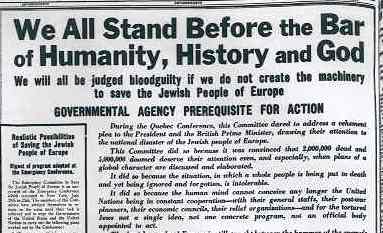
New York Times, Full Page Advertisement, 1943
Ben Hecht's greatest effort must be remembered as his awareness of the Holocaust of millions of Jews in World War II Europe when other Americans were ignorant, incredulous, or non-responsive. His collaboration with Kurt Weill on the 1943 Holocaust-awareness musical pageant We Will Never Die remains his stirring and frustrating effort to use musical theater to save millions of people in death camps and change world events.
This pageant came to Washington, DC where Eleanor Roosevelt and power brokers of the American government heard Hecht's special plea in which the actors, after the end of the pageant, remained onstage to make their case to take urgent action to save the Jews of Europe.
Florice Whyte Kovan, Hecht biographer/bibliographer, writer of this site.
Really good old news!
May 7, 2013.
Chicago area fans of Ben Hecht and others who can get to Chicago's North Side: Buy your tickets to 1001 Afternoons in Chicago by ACM Access Contemporary Music and the Strawdog Theatre.
Tuesday, May 21 7:00 PM
Architectural Artifacts
4325 N. Ravenswood Ave.
May 4, 2013 AND THE STORIES ARE . . .
The six Ben Hecht stories to be dramatized and set to music at a Chicago performance on May 21 in a collaboration between Access Contemporary Music and the Strawdog Theatre of Chicago are:
Grass Figures, Don Quixote and His Last Windmill, Thumbnail Lotharios, The Mother, Dapper Pete and the Sucker Play, and Clocks and Owl Cars, as revealed by ACM composer Seth Boustead, a Hecht aficionado who spearheaded the joint project.
Now Annotated! 101 Hard-to-Find Stories by Ben Hecht Removed to publish in book.
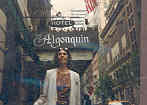
Above, a glimpse of Florice Whyte Kovan, writer/producer of books about Ben Hecht and the editor of this all-Hecht website. In the background is the Algonquin Hotel in New York, where Hecht was an associate of the Round Table literary set. Photo by Allan Kovan, circa 2000.
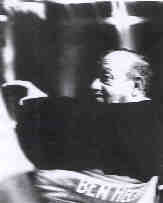
Ben Hecht on the movie set A Farewell to Arms, Hollywood. Courtesy The Newberry Library, Chicago.
About the writer of this site. Well, of course, Ben Hecht for his formerly lost stories, which I found on microfilm and reprint here.
It's also about time that after 20 years I introduce myself: I am Florice Whyte Kovan, the person who researches and writes this site. By virtue of education in Wisconsin (BA English ; MA and doctoral studies in Urban Studies), I am an urbanologist, a former community organizer and teacher of college Sociology. Inspired by my connection with Ben's childhood home in Racine, I managed to become an authority on certain aspects of Hecht's life and works and continue to research, write and speak on them. When awarded a study desk at the Library of Congress, I found all 425 of his 1001 Afternoons in Chicago stories, columns formerly accessible only as the 64 published in 1922 by Covici McGee. As the Snickersnee Press, I produced four annotated and illustrated thematic anthologies of them, each in an artist book and two subsequent editions: Rediscovering Ben Hecht: Selling the Celluloid Serpent, about the silent movie business in Chicago; Art & Architecture on 1001 Afternoons in Chicago, as well as a decorative millennial newsletter The Ben Hecht Story and News.
I sometimes supported my own writing and publishing as a research consultant to academic scholars and book publishers including Henry Holt for Pulitzer winner WEB DuBois by David Levering Lewis, the University of Chicago Press for the critique of the isolationist era Women of the Far Right by Glenn Johnsonne, a Pulitzer nomine and Viking Penguin for the copyright research on The Harlem Renaissance Reader. As the speaker at the University of Chicago's Doc Films' first series organized around a writer, instead of a director, I made the case for Ben Hecht. I storyboarded Hecht's 1943 pageant We Will Never Die for the US Holocaust Memorial Museum and continued for years as an intermittent volunteer. I was delighted to be the advisor to Hecht's character in the Broadway staging of Hutchinson's Moonlights and Magnolias, about Hecht's frenetic two weeks doctoring the Gone with the Wind script with David Selznick.
Now I am focusing on my own writing about Hecht's works and life. I am always happy when students, scholars and other writers find my published work informative. I welcome their questions about how they should credit this site as a research source. And I always hope to hear about a new Hecht event to post!
The Snickersnee Press Publishes only Ben Hecht (1894-1964) Biography and Works All rights reserved. Photograph below courtesy The Newberry Library, Chicago.
 This
This
web
site
is devoted exclusively to Ben Hecht and his literary associates. We publish researched anthologies of Hecht's 1001 Afternoons in Chicago stories, with emphasis on the formerly uncompiled ones, which I annotate and illustrate to inform his biography as well as to inform studies of cultural history: film, modernism, architecture, urbanism and art. I consider Ben Hecht as the early playwright, screenwriter and literary journalist in Chicago as these experiences informed his later work as a dramatist in New York, and in Los Angeles, where he became known as Hollywood's highest paid and least reverent screenwriter.
Visit this site and buy my books online and discover not just the legendary Ben Hecht but also the writer who emerges from the study of his life and newly found works, beginning with his Wisconsin boyhood and his salad days in Chicago.
BEN HECHT BIOGRAPHY HIGHLIGHTS
Born in New York City in 1894, Ben Hecht was the son of Joseph Hecht
 and Sara Swernovsky Hecht, garment makers from southern Russia. After several years in Chicago the family moved to the industrial inland seaport of Racine, Wisconsin. Here his father was a working partner in a womens' clothing factory, while his mother Sarah sold these wares as proprietor of the Paris Fashion store on Racine's Monument Square. Ben's Paris Fashion tasks involved writing advertising copy, doing window displays and, as he tells us, stoking the furnace in the basement under the women's fitting rooms. Shows at Racine's Bijou Theatre exposed young Ben to early films and illustrated songs between 1904-1910; but the circus touched him more closely inasmuch as the Hechts lived in a boarding house for circus people.
A Racine High School graduate, Hecht writes that he departed Racine in July of 1910 for a brief introduction to the college scene and fraternity life at the University of Wisconsin. He claims that he was asked to "apologize to the University" at a fraternity dinner table for his boast that he had already read the extensive freshman reading list. What, therefore, he thought, could UW possibly teach him?
ERGO, HE RECALLED -- all of this in his memoir, A Child of the Century, he fled immediately to Chicago. Particulars remain murky. Clearly, however, he focused on his literary attempts and connections early and throve in Chicago as the youngest, most creative and last to "defect" (to New York) of the Midwestern Literary Renaissance authors: Floyd Dell, Carl Sandburg, Margaret Anderson, Max Bodenheim, and Sherwood Anderson, the latter a rival of Hecht and for a time, his roommate. Hecht's real-time muckraking poem about the Titanic disaster appeared on the front page of the Chicago Journal and other papers less than two years after his high school graduation in Racine. Photo below courtesy The Newberry Library, Chicago 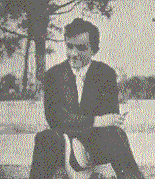
IN THE MID 1910s Hecht wrote avant-garde and other notable plays in Chicago's pioneer little theater movement with Kenneth Sawyer Goodman, the current subject of rediscovery and revival in Chicago and namesake of the Goodman Theater. The Little Review editor Margaret Anderson favored Hecht, encouraging his serious literary aspiration as he toiled daily as a reporter, first for the Chicago Journal, then for the Chicago Daily News. Retaining his day job as a celebrity news reporter, he began his screenwriting career no later than 1915 when he teamed with John Emerson and Anita Loos as an uncredited scenarist. In 1919 Hecht served as a post-war correspondent in Berlin, an experience that invigorated him artistically and exposed him to international politics, to Berlin Dadaists Georg Grosz and Johannes Baader as well as to the European silent film production scene.
On returning to Chicago, he wrote daily columns for the Chicago Daily News in his own series 1001 Afternoons in Chicago, establishing himself as a prolific and inventive short story writer and essayist. He would find material for some of these stories by sitting on his favorite park bench in Grant Park (seen above) contemplating the urban scene and the profusion of diverse people. The stories are sometimes described (by Eastern critics) as Runyonesque in their character studies, but Ben Hecht inspired the critical term Hechtean in his taboo-breaking youth. During his flourish of literary journalism in the early 1920s, he also completed his major novels, Erik Dorn, followed by Gargoyles, Fantazius Mallare, The Florentine Daggar, Kingdom of Evil and several plays, among them The Egoist. His arts and literary tabloid The Chicago Literary Times, of which Max Bodenheim was initially co-editor, lambasted Chicago's reactionary arts establishment while promoting the works of Hecht's artist friends George Grosz, Herman Rosse, Wallace Smith, Stanislav Szukalski and the cause of the avant-garde "No-jury" artists of Chicago.
His "50 Books That Are Books" reading list reveals literature that influenced his later scenario writing.
IN 1925 HE RETURNED TO A NEW YORK where the Algonquin Round Table was the locus of literary prestige and, for a time, he took a seat there.
His work for Paramount Astoria Studios during this
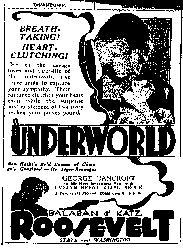
period was uncredited to evade alimony obligations. When at the first Academy Awards he won the first Oscar ever awarded to a writer, for the Hollywood silent film Underworld, he remained at home in New York. His initial refusal of the statuette (he used it as doorstop when it was later sent to him) set the precedent for more dramatic refusals by other recalcitrant albeit wordy winners over the years. After his awards for Underworld and the Pulitzer winning The Front Page with Charles MacArthur, Hollywood wooed him with lavish fees. In the 1930s he and Mac Arthur wrote. produced and directed films at the Astoria Studios in Queens. Despite his iconoclasm and Hecht's acerbic criticism of Hollywood, they won an Oscar for The Scoundrel, which starred Noel Coward in a roman a' clef about the New York publisher Horace Liveright.
HECHT'S FILM CONTRIBUTIONS spanned comedies (Nothing Sacred, Monkey Business) family fare (Jumbo, Roman Holiday), novel to film adaptations: Wuthering Heights, Gunga Din, A Farewell to Arms; political satire Hallelujah, I'm a Bum, Roxie Hart (the first screenplay of the later blockbuster Chicago), Hitchcock suspense in Spellbound; Rope, Notorious, the latter an Oscar nominee, and, under protest, remedial scripting for Gone with the Wind. Films he directed included Angels over Broadway and the noir Spectre of the Rose about a mad ballet dancer. He became a New York-Hollywood commuter, maintaining homes in Nyack and Central Park West.
His greatest effort must be remembered as his awareness of the Holocaust of millions of Jews in World War II Europe when other Americans were ignorant or incredulous. Hecht's collaboration with Kurt Weill on the 1943 Holocaust-awareness musical pageant We Will Never Die remains his stirring and frustrating effort to use musical theater to turn world events.
His California mansion was at Oceanside, reflecting a love of "the great sea Lake Michigan" Ben espoused in his Racine boyhood and his youth in Chicago. 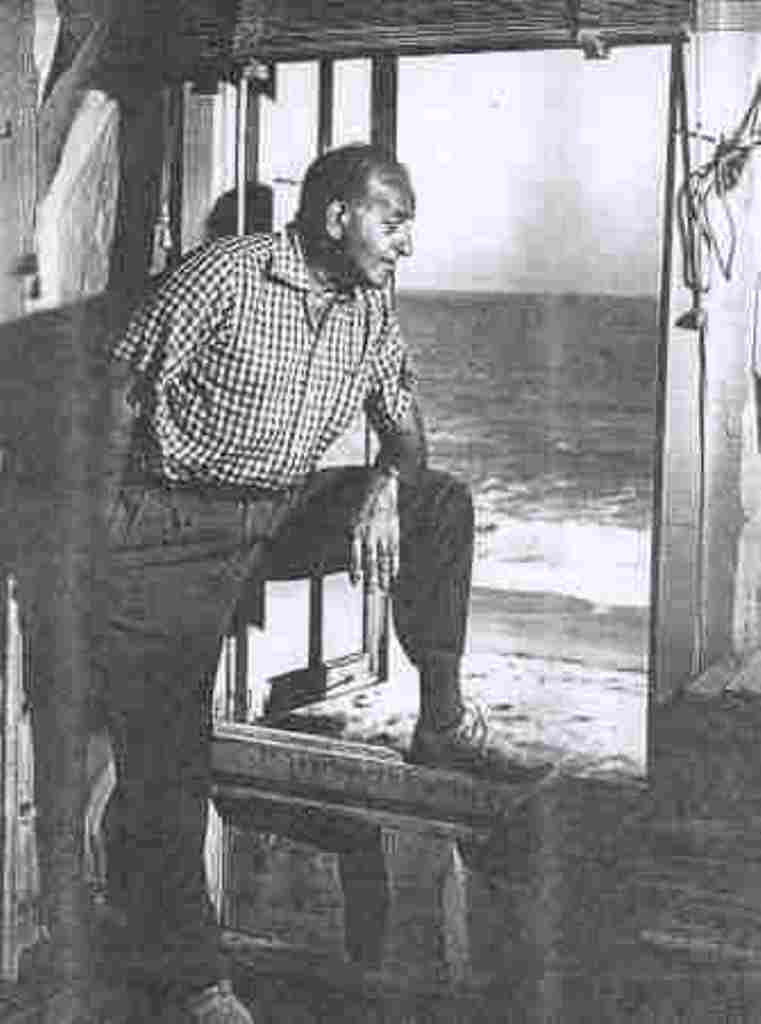
Picture credits this column, from top. 1 The Newberry Library, Chicago. 2. Snickersnee Press. 3. The Newberry Library, Chicago 4,. 5., Library of Congress General Collections 6. Library of Congress prints and Photographs.
Learn something you didn't already know? If so your credit line should include the writer's name, Florice Whyte Kovan, Snickersnee Press, www.benhechtbooks.net, URL of this page and date.
For licensing contact us.
The Snickersnee Press
431 Fifth Street NE
Washington, DC 20002
fax: 202 547 0132
snickers