Ben Hecht Biography & Books at the Snickersnee Press
431 Fifth Street NE
Washington, DC 20002
fax: 202 547 0132
snickers
Ben Hecht Event Archive
Ben Hecht Preservation: Who Did What?
We posted Ben Hecht preservation news on our snickersneepress.com website and then archived the notes for future reference for Hecht scholars preservationists. Copyright Florice Whyte Kovan, all rights reserved.
Ben Hecht This Week
April 29, 2008
With the purchase of the Wrigley chewing gum company by the Mars Company, we think of Hecht's Chicago Daily News story about the evocative Wrigley Building. Despite the erection of taller buildings in Chicago, it's site and illumination at the mouth of the Chicago River renders the Wrigley Building a special place for Chicago natives and visitors (see view, right). The story was "Enchanted Exiles," reprinted by the Snickernsee Press in our book, Art & Architecture on 1001 Afternoon in Chicago. It tells of the love of the building by Hecht's Dadaist friend from Berlin, George Grosz and is illustrated with a postcard of the Wrigley Building Grosz sent to Hecht.
Next week see our picture of Ben Hecht's mother, Sarah.
Ben Hecht This Week
We note that April 30, 1935 was the release date for the Ben Hecht, and Charles MacArthur movie The Scoundrel, for which they won the Oscar for original screenplay writing. The redemtion story starred Noel Coward as a character inspired by New York publisher, Horace Liverright, who was known to the writing duo. The Hecht papers are sprinkled with letters to editors, superb query letters about book projects and acrid ones disputing his receipt of royalties.
Ben Hecht This Week
April 19, 2008
The April 19, 1943 anniversary of the Warsaw Ghetto uprising of Polish Jews willing to die fighting instead of in Nazi death camps also recalls the efforts of Ben Hecht to commemorate this event in the consciousness-raising pageant he wrote, We Will Never Die, for which Kurt Weil composed the stunning musical score. The pageant played star-studded one-day performances at Madison Square Garden, the Hollywood Bowl as well as inWashington, DC, Boston, Philadelphia and Chicago. The Greek actress Katina Paxinou (For Whom the Bell Tolls) gave a thrilling performance as narrator of the Warsaw Ghetto scene.
April 15
The story an 18 year old Ben Hecht filed about the Titanic was written as the ship was sinking, a news blackout imposed by the ship's owner. Read all about how it made the front page on our Hecht Titanic page.
April 13, 2008
Ben Hecht died April 18, 1964 at his apartment home in New York Central Park West, survived by his wife Rose and a daughter from his first marriage. Just weeks before, he wrote of his pleasure that he was to be the first screenwriter subject of a Hollywood movie, Gaily, Gaily, based on a portion of his memoir of the same name.
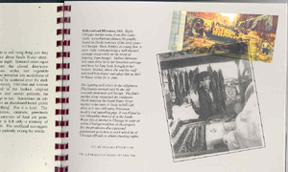
In our artist book of Hecht's Chicago art stories, we illustrate Hecht's story about the Water Street Market with a 1910 postcard view and a film still from the market scene in Gaily, Gaily with a hungry Hecht played by Beau Bridges.
April 6, 2007
On April 6 1917 the United States declared war against Germany. Ben Hecht covered the effect of that war on Germans in 1919. On returning home, he wrote a haunting, timeless story about a disabled veteran he saw at the Chicago subway stop.
March 26, 2008
Goodbye, Richard Widmark
Died today at 93, Richard Widmark, accomplished actor, perhaps best remembered today for his role in Ben Hecht's screenplay Kiss of Death where, giggling creepily, he pushed an elderly woman down the steps in her wheel-chair.
CHICAGO, APRIL 2004. BIG NEWS! Doc Films, the time honored and much lauded student-run film society at the University of Chicago, announces its spring series: "Ben Hecht: Classic Hollywood Screenwriter" April 4 - May 30. Organizer Kathy Geier says it all: "We are very excited about this series,"
And we are too! For years film revivals have omitted Hecht, celebrated him among other writers and even included him generously. However generous the shared billing, Hecht deserves his own film revival and serious consideration of his film aesthetic.
Geier reports that Doc acquired high-quality archival prints for Design for Living, Hallelujah I'm a Bum, Gunga Din, and His Girl Friday. The first two along with Underworld are little-seen in revival, on television or in video stores.
"We feel that it's especially appropriate that University of Chicago honor Hecht, given Hecht's status as a longtime resident of Chicago in general, and of our neighborhood, Hyde Park . . ." says Geier, who lives just a block from the house Ben and Marie lived in the late teens and early 1920s.
The world of Hecht fans thanks Doc for sponsoring a true all-Hecht series, for finding such rare goodies as the silent film Underworld; for which Hecht won the first writing Oscar, for Angels over Broadway and Hallelujah I'm a Bum and for bringing them back to the old neighborhood. Here Hecht developed from a Chicago Renaissance writer to an early modernist and sustained an intense feeling of spiritual home and, indeed, of loss, after he left for New York and Hollywood
VANCOUVER. June 2003. About George Fetherling's recent review of What I Saw, Reports from Berlin, by Joseph Roth, translated by Michael Hoffman (Penguin, Canada): Fetherling, who in 1977 wrote what stands out as the best of the books about Hecht, The Five Lives of Ben Hecht, sees the relationship between Roth's journalistic letters (feuillton) and the 1001 Afternoons in Chicago literary journalism Hecht began to write for the Chicago Daily News after returning from his year in Berlin 1919. The full page review appears with an image of a painting by George Grosz in the Vancouver Sun, June 14, 2003.
WASHINGTON. 2003. Correcting the stats. The number of Ben Hecht 1001 Afternoons in Chicago titles to be published in Snickersnee's new artist book, Bibliocityscape, a design driven list, is not 404 but 422.
RACINE, WISCONSIN. A HOUSE OF BEN HECHT'S
CHICAGO. Spring 2003. Walter Roth, no relation to the aforementioned Joseph, devotes a chapter to Hecht in his new book Looking Backward : True Stories from Chicago's Jewish Past (Academy Chicago Publishers). A contribution of the book is the reprinting of some of the transcript of Hecht's 1943 pageant, We Will Never Die, an extravaganza intended to arouse American Jewry and others to lobby the White House and Congress to expose the Holocaust and attempt to rescue its victims. Roth breaks the pattern of ambivalance toward and diminishing of Hecht on the part of American Jewish thinkers by embracing Hecht as a son of the Chicago literary remaissance of the 1919s and a passionate anti-Holocaust writer and activist.
KUUSANKOSKI, FINLAND. Librarian, bibliophile and book reviewer Petri Liukkonen has done nice work in chronicling Hecht and finding good quotes on his site about him and other American authors at http://www.kirjasto.sci.fi/calendar.htm/
CHICAGO. "Look you, the radio is just beginning," cried Hecht in an optimistic Chicago Daily News piece about culture and technology of the 1920s. Some 80 years later, on Sunday, August 18, Rick Kogan read from Snickersnee's new Hecht book, "Art & Architecture on 1001 Afternoons in Chicago" and talked with editor Flori Kovan on WGNradio.com/ An historic radio giant, WGN is at 720 on the AM band and can be heard in 38 of the American states when you leave the computer.
WASHINGTON. DC. Cindy Loose's article about Studs Terkel's Chicago appeared in the Washington Post (June 23). Many of the Chicago landmarks and phenomena that excite Terkel excited Ben Hecht before him. Congratulations to Loose for celebrating Chicago's landmark institutions, not least of which is the venerable Studs Terkel.
FILM FORUM of New York showed Ben Hecht's creative hand in Nothing Sacred, Monkey Business (uncredtied) Twentieth Century, Shop around the Corner (uncredited) and His Girl Friday (gender reversal based on The Front Page) in its Great American Comedy series produced by Bruce Goldstein March 29-June 6 at 209 West Houston Street.
CHICAGO. The Jazz Age Chicago site by Scott A. Newman is a gift to the on-line study of Chicago leisure between 1893-1934. Anyone who wants to get the feel of Hecht's Chicago 1910-1925 should delight in starting here. It contains many complete articles from that time span and is nicely constructed with subject access.
VICTORIA AUSTRALIA. A thorough and passionate review of Hecht's film Spectre of the Rose by Donald Phelps appears in the Australian online journal SENSES OF CINEMA, Issue 19 (March-April 2002) at sensesofcinema.com/ Hecht wrote and directed the film.
CHICAGO, The Chicago Tribune started some long overdue buzz about Ben Hecht recently when they published Robert Schmuhl's article about the challenges he faced in assessing Hecht's career when he began to examine Hecht's papers at the Newberry Library. We welcome a dialogue about Hecht. Read Mr. Schmuhl's illustrated article in the Book section of the Chicago Tribune of Sunday, March 31, 2002.
RACINE, WISCONSIN. The Racine Public Library is reviewing its holdings against Ben Hecht's booklist, "50 Books That Are Books" for a prospective exhibit: and what could be more apt? Hecht became a bibliophile in Racine and read some of these very books at that very library (at least the ones they would permit youngsters to read).
KUUSANKOSKI, FINLAND. Librarian, bibliophile and book reviewer Petri Liukkonen has done nice work in chronicling Hecht and finding good quotes on his site about American authors at http://www.kirjasto.sci.fi/calendar.htm
WASHINGTON DC. Florice Whyte Kovan, a Hecht researcher for 15 years, is writing a book spanning Ben Hecht's life and works for publication in the next year. She has already catalogued the entire 1001 Afternoons in Chicago stories, over 400. The book will include an illustrated chronology of his film and stage works (thus we have discontinued her Ben Hecht Film of the Week page here).
431 Fifth Street NE
Washington, DC 20002
fax: 202 547 0132
snickers